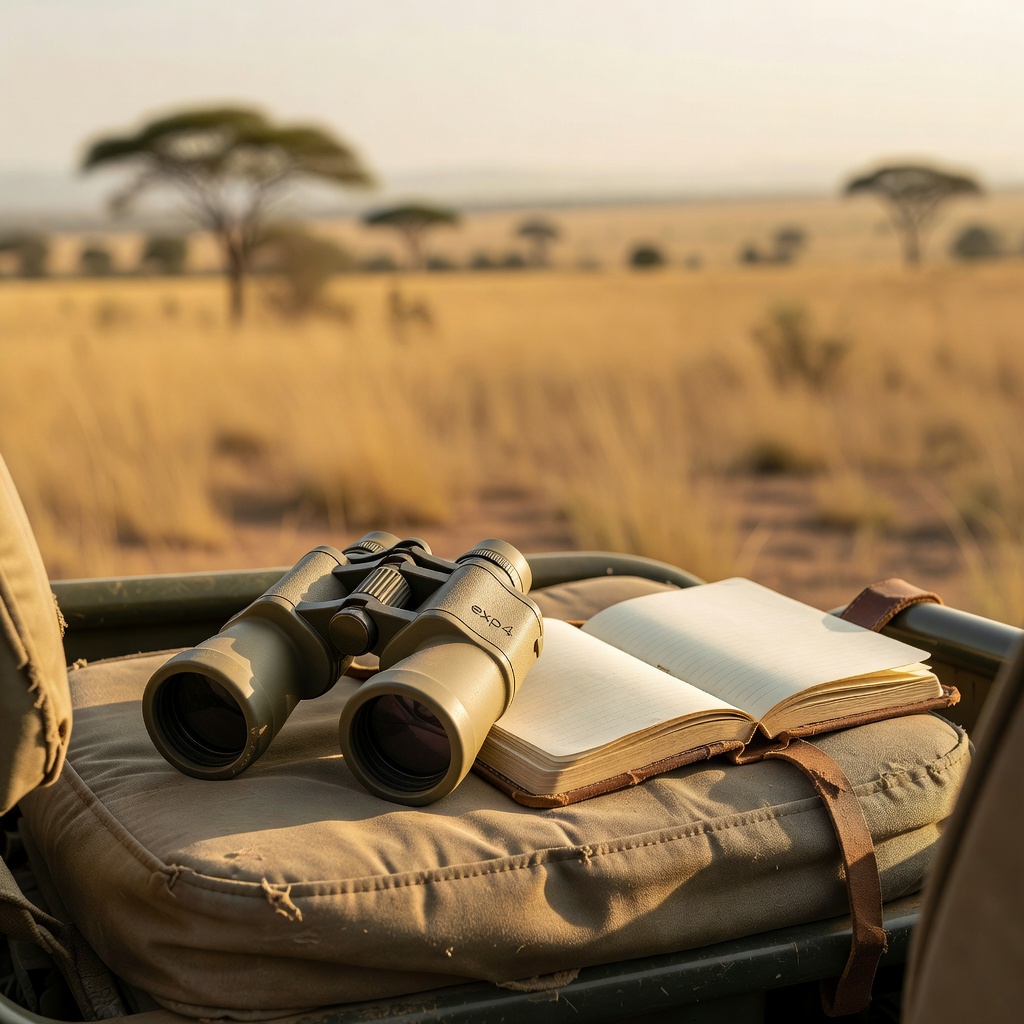
Where today's logs are written
Four landmarks dominate the modern safari map. South Africa's Kruger National Park, proclaimed in 1926, is one of the oldest and most accessible, with self-drive routes and rest camps. Tanzania's Serengeti National Park, established in 1951, hosts the great wildebeest migration, which continues north into Kenya's Maasai Mara National Reserve, set up in 1961. Botswana's Okavango Delta became UNESCO's 1,000th World Heritage Site in 2014, a maze of channels best logged from a mokoro, the traditional dugout canoe.
Each place rewards a slightly different log. In Kruger you'll record road names and waterholes; in the Serengeti, migration movements and grass conditions; in the Okavango, water levels and the birds of the reed beds.
The kit list
- A pocket notebook for the vehicle, ideally waterproof, plus a larger journal for the evening.
- Two pencils and a sharpener, tied to the notebook with string so they don't vanish down the seat.
- A regional field guide to mammals and birds, to check names before you write them.
- Binoculars — 8×42 or 10×42 are common choices for safari.
- A small zip bag to keep dust out of everything.
A daily template
Borrow from the Grinnell method (see Expedition Two) and open each day with the same header:
Then, for each sighting: time, species, number, age or sex if known, behaviour, distance and habitat. Close the day with three lines of reflection and a running species count.
Write sightings as they happen and keep reflections for the evening. "14:20, lioness, 1 adult, stalking impala herd, 50 m, acacia woodland" will still mean something in twenty years. "Amazing lion!" won't.
Sketch, even badly
A thirty-second sketch of a vulture's head or a giraffe's coat pattern forces you to look. Many guides say sketching travellers notice more than photographers. Your drawing doesn't need to be good; it needs to be honest.
Field ethics for the modern logbook
Old explorers wrote with little thought for consequences. You can do better. Never share precise locations of rhinos or other poaching-targeted species — parks including Kruger have asked visitors not to geotag rhino sightings. Follow park rules: stay in your vehicle where required and keep to roads. Ask permission before writing about or photographing people, and record the names of guides and trackers whose expertise made the sighting possible. Their knowledge belongs in the log as much as yours.
After the trip
Within a week of returning, transcribe your species list, scan the notebook and add an index to the first page, as we described in Expedition Three. If you want your sightings to help science, platforms that follow Darwin Core terms can accept well-recorded observations. Then shelve the notebook somewhere cool and dry. You have just joined a tradition that stretches back to the Beagle.
Dispatch timeline
- 1926Kruger National Park is proclaimed in South Africa.
- 1951Serengeti National Park is established in Tanzania.
- 1961The Maasai Mara National Reserve is set up in Kenya.
- 2014The Okavango Delta is inscribed as UNESCO's 1,000th World Heritage Site.